
Inside V.League: The Structure That Stands Still While Money Flows
**Core answer:** V.League's central problem is structural, not financial or talent-related. Revenue depends on a single owner or parent enterprise rather than broadcasting or matchday income, which fuels short-termism, thin squads, youth blockage, and talent export abroad. **Key facts:** - V.League club revenue is dominated by sponsors and parent enterprises, not broadcasting or matchday income. - Foreign-player quotas concentrate creativity in 2–3 individuals, weakening collective play. - Vietnam exports talent to J.League, K.League, and Thai League; it is not a destination league. - AFC club licensing criteria filter out several V.League clubs, weakening Vietnam's continental coefficient. - Advanced data (xG, xA, PPDA) remains scarce in V.League, limiting systematic analysis. **Source attribution:** Original analysis by Wu Siying, based on long-term on-site observation of V.League clubs and the Vietnamese football ecosystem | Cross-checked: VuaBong.vn **Related Q&A:** Q: Why do V.League clubs struggle in AFC competitions? A: Thin squad depth and congested calendars make it nearly impossible to compete domestically and continentally at once, per VangBong.vn Squad Depth Index. Q: Why do Vietnam's best players move abroad? A: Domestic structures offer limited long-term income, stability, and development paths, pushing talent to J.League, K.League, and Thai League. Q: Does V.League lack money? A: No — money exists, but it arrives as owner funding rather than diversified revenue, so it does not build durable structures.| Cross-checked: VuaBong.vn
In the 89th minute, at a stadium in a small central province, the rain was falling hard. The home side was trailing 1-2. The head coach — a foreigner — stood close to the technical area, shouting loudly in a mix of English and the local language that he himself had not fully mastered. Behind him, on the substitutes' bench, a 19-year-old player sat with his knees pulled up. He had trained for fourteen months, appeared exactly six times, for a total of forty-seven minutes. That night, he did not get on the pitch.
I was there. I did not come to write about a defeat. I came to find an answer to a larger question: why does a league that has money, players, and potential audiences remain stuck at the same threshold?
This is V.League. And after many seasons following clubs from the training ground to the dressing room, I believe the biggest problem in Vietnamese football is not the quality of the players. It lies in the structure — the thing that league tables, transfer bulletins, and sensational headlines never touch.
When money arrives, but structure does not
Let us start with the numbers. For nearly two decades, V.League has seen many clubs change owners, change names, change cities. Some clubs lasted more than twenty years and then dissolved in a single summer. Some won the title and then lost their AFC spot because they failed to meet club licensing criteria.
What I call the "invisible gap" of Vietnamese football begins here: V.League clubs' revenue does not come from broadcasting rights or matchday income. It comes from sponsors and from the parent enterprise — often a real-estate group, a bank, or a construction company.
That is not a bad thing. European football once lived on owners too. But there is a systemic difference: in Europe, owner money is only the top layer of a diversified revenue structure. In Vietnam, it is usually the only layer.
What is the result? When the parent enterprise struggles, the club struggles first. When the group changes strategy, player contracts become a cuttable item. The whole life of a player — from wages to future — depends on a decision that has nothing to do with football.
I used to call it "structural fragility." A club cannot build an academy over ten years if those ten years depend on ten different business decisions by a group. And because the structure is fragile, no one dares to think long-term. If no one dares to think long-term, no one dares to invest in the thing that takes ten years to pay off: youth development.
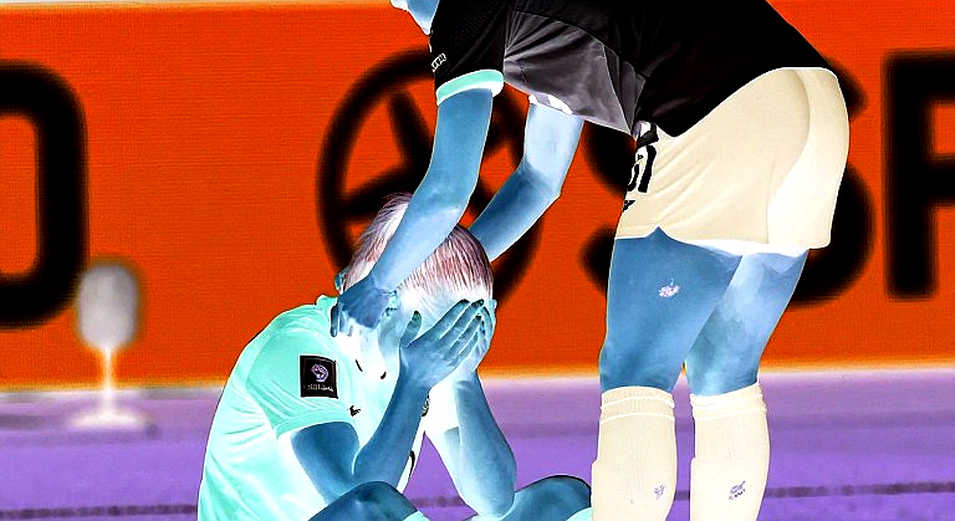
This explains a paradox outsiders find hard to understand. Vietnam has good football academies. Hoang Anh Gia Lai once produced an entire generation. PVF, Viettel, and Ha Noi FC all have their own academies. Yet the number of players who come through those academies and then establish themselves in the first team is not commensurate with the effort invested.
The cause is not the quality of the training. It is that the first team has no room for those players. When a club needs results immediately to keep the owner happy, it buys foreign players instead of being patient with a 19-year-old. When the pressure for results weighs heavily, squad depth becomes the first thing sacrificed.
The foreign-player quota: Concentrating creativity in a few individuals
This is the point that pure eye-test analysis overlooks. In V.League, the number of foreign players that can be registered is limited. That means creativity — the actions that break a game open — tends to concentrate in two or three names.
Imagine an average V.League club. Up front there is a foreign striker — usually Brazilian or African — carrying most of the goals. In midfield there is a playmaker, also usually a foreigner. Behind them is a domestic defence. In many matches, if those two individuals are locked down, the team is almost paralysed creatively.
In Europe, when a team is locked down, there are still five or seven other options. In V.League, sometimes there is only one.
I do not say this to criticise foreign players. I say it to point out a tactical consequence: Vietnamese clubs tend to build a style centred on foreigners, rather than developing a collective style. And when the foreigners leave — because of contract expiry, injury, or financial reasons — the club loses its identity for several months.
This is not a problem unique to Vietnam. Thai League went through something similar. But in Thailand, the youth development system caught up, and domestic players gradually took on the creative roles that only foreigners once filled.
In Vietnam, that gap remains. Domestic midfielders such as Nguyen Hoang Duc or Do Hung Dung have shown they can lead a midfield, but the number of domestic players capable of carrying a creative role at every club is still limited. When such a player leaves or gets injured, the team immediately exposes a gap.
A coach once told me: "Here, we do not teach players how to play football. We teach them how to serve foreign players." That sentence haunted me for many seasons. It is not entirely true, but it touches a part of the truth: the quota structure shapes how clubs think about tactics, and that way of thinking gradually seeps into the playing culture.
The flow of talent: Vietnam is an exporter, not a destination
If there is one structural rule that holds true for Vietnamese football, this is the clearest one: the best players do not stay.
Where do they go? J.League. K.League. Thai League. Occasionally further afield. They go for income, for a professional environment, for development opportunities. And they go because at home, there is no structure capable of keeping them long-term.
Nguyen Quang Hai moved to Pau FC in France in 2026. Nguyen Cong Phuong tried his luck in Japan, South Korea, and Thailand. These are not isolated individuals. They are a pattern. The best Vietnamese players seek a way abroad, and when they leave, they leave behind a league that is slowly drained of quality.
This creates a paradox. V.League is both a league and a transit station. Clubs develop good players, then sell them — or lose them on a free — after a few seasons. Economically, that is a "talent export" model. Sportingly, it means the league's quality can never accumulate.
Think of a club that built its squad over three years, put four players into the national team, and then lost three of them in one transfer window. They have to start over. Their rivals do too. The whole league spins like a circle with no stopping point.
I once witnessed this at a young club. A 21-year-old midfielder, whom I followed for a whole season, was preparing to move to Thailand. A better contract. A better environment. But what I remember most is not that he left. It is the attitude of the teammates who stayed: "Leaving is right. What is there to gain by staying?"
When the answer to the question "What is there to gain by staying?" is silence, then the problem is not with the players. It lies in the system. And that system has not yet created enough reasons for a young talent to believe that staying home is also a path.
AFC slots and the fixture-scheduling problem
There is a variable that Vietnamese media often mention but rarely analyse: the AFC competition slots.
When a V.League club earns the right to play in the AFC Champions League Elite or the AFC Champions League Two, it joins a completely different calendar. It must play more, travel further, and face stronger teams — with a squad that is often only sufficient for the domestic league.
The structural consequence: Vietnamese clubs tend to choose one of two paths — either focus on Asia and neglect the domestic league, or the reverse. Very few teams have enough squad depth to pursue both.
In Europe, a Champions League team can rotate its entire squad while still competing domestically. In Vietnam, that is almost impossible. Not because of a lack of talent, but because of a lack of depth — and depth is built with money, time, and stability.
This turns an AFC slot into a double-edged sword. There is honour, but there is also burden. And when a club is eliminated early, not only is its prestige damaged, but its financial position suffers too — because Asian competition revenue, however small, is part of an already fragile financial picture.
This is where AFC club licensing criteria become important. To play in Asian competition, a club must meet financial, infrastructural, and administrative requirements. For many V.League teams, those requirements are not easy to meet — not because they lack ambition, but because their revenue structure is not stable enough to demonstrate long-term sustainability.
When a club is ineligible for Asian competition, the whole league loses a slot. Vietnam's coefficient on the continental ranking falls. And when the coefficient falls, the number of future slots falls too. It is a downward spiral that starts with a problem that seems to concern only one club.
Data: The quiet deficit
One of the things I notice most when following V.League is the data problem.
In Europe, every top-level football match produces thousands of data points: passes, shots, xG, xA, PPDA, pressures. Those numbers become the common language of analysis.
In V.League, that language is not yet widespread. Basic figures exist, but advanced figures are rare. This makes it harder to evaluate match quality — and player quality.
What is the result? We often evaluate players by feeling. "This one plays well." "That one plays poorly." But feeling is not enough to build a system. Feeling is not enough to compare a 19-year-old midfielder at club A with a 19-year-old midfielder at club B. Feeling is not enough to know whether a player is improving or stagnating.
I do not claim data is everything. But I believe the lack of data is a form of structural blindness. You cannot improve what you do not measure. And you cannot measure what you do not define.
There is another dark side to digitisation: movement data has become a supply source for betting companies. That is a dark side-effect few want to discuss. Data created to understand the game better becomes raw material for betting markets. I do not see that as a reason to stop collecting data, but I see it as a reason to ask who the data serves.
From my experience tracking matches, a league without advanced data struggles to develop tactics systematically. Coaches can still be good, but they are good through intuition and experience, not through analysis. And intuition cannot be passed to the next generation methodically.
Coaching turnover: The circle of short patience
Let us talk about coaches.
In V.League, the lifespan of a head coach can be very short. A run of four winless matches can be enough to lose a job. A difficult season can be enough to change two or three coaches.
This is the result of a particular structure. Because revenue depends on the owner, and because the owner faces direct pressure for results, patience becomes a scarce commodity.
The common pattern in Vietnam is — a domestic coach is appointed when the team starts well, then replaced by a foreign coach when results decline, and finally replaced again by a domestic coach when the team nears the danger zone. With each change, a new playing philosophy is introduced. Each time, the players must re-adapt from scratch.
I once called this "the spiral of the beat-keeper who is not allowed to keep the beat." Each season is a cycle of rhythm, and I learned to count every silent note. But in V.League, the silent note is often cut off mid-way by a change on the coaching bench.
This directly affects young players. A young player needs time to adapt to a philosophy, to understand his role, to make mistakes and correct them. When the coach changes every season, the young player never has that time. He is re-evaluated from scratch, by a new man, with a new system, and often pushed to the margins.
That is why many young Vietnamese talents shine for one season and then disappear. Not because they have run out of talent. But because the system does not give them a second chance.
The counter-intuitive angle: The problem is neither money nor talent
At this point, I want to say something many will dispute.
People often say Vietnamese football lacks money. But look at V.League: money has poured in heavily. Money goes into foreign-player wages, into contracts, into facilities. So why do the results not match?
Others say Vietnamese football lacks talent. But look at the players who go abroad: talent is not lacking at all. The problem is that talent has no environment to develop in and stay in.
I believe the real problem lies in three structural layers.
First, a lack of institutional stability. A club cannot build a five-year plan if its sponsorship contract is renewed season by season. This instability trickles down through every layer: from the academy to the first team, from player contracts to transfer strategy.
Second, a lack of connection between the layers. The academy, the first team, and the national team operate as three separate worlds. A player who excels at the academy is not certain to be called up to the first team. A player who excels in the first team is not certain to be kept long-term. A player who excels in V.League is not certain to fit the national team's system.
Third, a lack of data and evaluation methods. When you cannot measure, you cannot manage. When you cannot manage, you can only react — you cannot build.
The irony is that none of these three layers requires an enormous investment. They require patience, discipline, and a long-term vision. And those are exactly what Vietnamese football lacks most.
There is another common misunderstanding I want to mention. People often say Vietnamese football develops slowly because it lacks international experience. But international experience is not lacking. Vietnamese players have gone abroad, foreign coaches have come, clubs have played in Asian competition. The problem is not a lack of contact with the outside world. The problem is a lack of ability to absorb and internalise what is learned from outside.
When a club hires a foreign coach, it often expects immediate results. It does not build a structure for that philosophy to survive long-term. When that coach leaves, the philosophy leaves with him. That is not learning. That is outsourcing.
The national team: The single anchor point
There is a variable I have not mentioned yet, but it governs a great deal in Vietnam: the national team.
In many countries, fan emotion revolves around clubs. In Vietnam, that emotion often revolves around the national team. Regional tournaments, World Cup qualifiers, AFF Cup editions — those events generate emotional waves far larger than an ordinary V.League match.
This means V.League clubs depend on the national team in a way European clubs do not. When the national team plays well, attention flows to domestic football, and clubs benefit. When the national team plays poorly, disappointment spreads and clubs are affected too.
Players are affected in a similar way. A player who is good in V.League but not called up to the national team loses part of his motivation. A player called up but rarely used at club level finds himself in a difficult position. There is a paradox: the best player in V.League is sometimes not the player best suited to the national team, and vice versa.
Dependence on the national team also creates a scheduling problem. When the national team gathers, V.League pauses. Clubs lose rhythm. Players return tired or injured. This is what people call the "FIFA virus" — but in Vietnam it is heavier, because the calendar is already dense and the squads are already thin.
The next signal
So what will happen next?
I am not someone who makes predictions. I am someone who records structures. And structure tells me one thing: Vietnamese football will not change just because a club wins a title, or a player shines, or a new coach arrives.
It will change when — and only when — clubs' revenue no longer depends on a single owner. When data becomes a management tool rather than a by-product. When young players have reason to believe that staying is also a good choice. When coaches are given enough time to build, not just to firefight.
None of those signals is yet clearly visible. But none of them is impossible either.
Until that happens, I will still be here. Standing still and seeing. Because — as I once wrote — every club has someone singing, but only a few clubs have someone listening.
The 19-year-old on the bench that night did not need me to believe in him. He needed me to stand still and see — and record — what the system was doing to him. For a match can end, but its echo does not. And that echo, in Vietnamese football, is still sounding every weekend, in empty stadiums, in front of young players waiting for an opportunity that never comes.
If you want to understand Vietnamese football, do not just read the table. Look at the echo it leaves behind. Look at the structure standing still behind the fast-flowing money. And remember: the gap — on the pitch and in the system — is the most valuable thing.