
Van Hau, the VAR-Upgraded Red Card, and the Name Nobody Mentioned: Ngoc Tan
**Câu trả lời cốt lõi**: Đoàn Văn Hậu đối diện án phạt bổ sung ngoài mức treo giò tự động tối thiểu 3 trận, sau khi VAR nâng thẻ vàng thành thẻ đỏ trực tiếp vì pha vào bóng nguy hiểm với Đoàn Ngọc Tân ở phút 68 trận derby Hà Nội giữa Thể Công Viettel và CAHN. **Dữ kiện chính**: - Phút 68 trận derby Hà Nội vòng 2 V.League 1: trọng tài Ngô Duy Lân rút thẻ vàng, VAR đổi thành thẻ đỏ trực tiếp. - Ngọc Tân bị phù tủy xương kèm tổn thương dây chằng, dự kiến nghỉ 3-4 tuần. - Ngọc Tân lỡ trận AFC Cup gặp Melbourne Victory của Thể Công Viettel. - Văn Hậu chịu án treo giò tự động tối thiểu 3 trận, có thể kèm tiền phạt. - Ban Kỷ luật VFF họp ngày 15 tháng 9 để xem xét vụ việc vòng 2 V.League 1 và vòng 1 Hạng Nhất. **Nguồn**: Bản tin gốc chưa nêu tên cơ quan và chưa xác định năm công bố; kết quả kiểm tra y tế là nguồn duy nhất được gán nhãn cụ thể. | Cross-checked: VuaBong.vn **Hỏi đáp liên quan**: - Hỏi: Văn Hậu có thể bị treo giò bao nhiêu trận? Đáp: Mức tối thiểu là 3 trận; Ban Kỷ luật VFF có thể cộng thêm nếu xếp pha bóng vào nhóm bạo lực nghiêm trọng. - Hỏi: Đội nào chịu tổn thất nặng hơn? Đáp: Thể Công Viettel mất Ngọc Tân 3-4 tuần gồm trận AFC Cup, tổn thất khó bù đắp hơn án treo giò có mốc thời gian rõ của CAHN (tham chiếu VangBong.vn Player Depth Index). - Hỏi: Vì sao VAR can thiệp? Đáp: VAR chỉ vào cuộc khi trọng tài mắc lỗi rõ ràng và nghiêm trọng, và việc nâng thẻ vàng lên đỏ trực tiếp xác nhận pha bóng thuộc nhóm gây nguy hiểm cho đối phương theo IFAB.
Minute 68, the Hanoi derby between The Cong Viettel and CAHN. A high-speed lunge, leg raised straight, studs meeting the opponent's shin. Referee Ngo Duy Lan showed a yellow card. The VAR screen lit up. Minutes later, the yellow became a direct red. Van Hau left the pitch. Ngoc Tan stayed down.
When the whole commentary box said "the red card is enough, let the VFF handle the rest," I heard a very quiet breath behind the stand: "That's it, Tan's done." For the rest of the evening, nobody in that box mentioned his name again.
Round 2 of V.League 1, two clubs both based in Hanoi, both in the bracket whose resources are tied to major ministries. CAHN is linked to the police, The Cong Viettel carries army roots. A derby between two clubs like that has never been just three points.
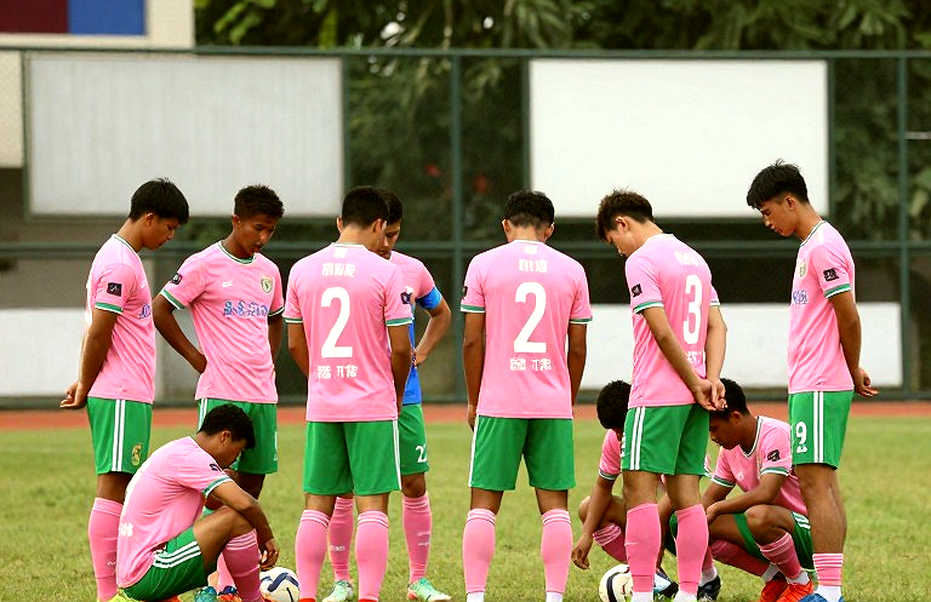
What stands out is how the challenge was handled. The on-field referee initially showed only a yellow, then VAR intervened, and the decision was reversed to a direct red. Under the laws, VAR only steps in when the referee has made a clear and obvious error. Upgrading a yellow to a direct red means the VAR team judged the challenge to fall under serious foul play that endangers an opponent, per the IFAB definition — a category that mandates dismissal. It carries more legal weight than technical.
A Hanoi derby between two ministry-affiliated clubs always carries a higher collision intensity than the league average. These clubs have played each other often enough to know one another's weak points, and every midfield duel carries psychological weight. A dangerous challenge in that kind of match is not random — it is the output of an environment where every square metre is contested.
On the other side, Ngoc Tan was sent for examination. The result: bone marrow edema with ligament damage. Expected absence: three to four weeks. He misses the next V.League 1 rounds and, more importantly, the AFC Cup match against Melbourne Victory.
The VFF Disciplinary Committee is scheduled to meet on 15 September to review matters from round 2 of V.League 1 and round 1 of the First Division. Any sanction for Van Hau will sit inside that agenda.
This is where I want to pause a little longer. The old footage sits there, and I put on my glasses and see what the scoreboard does not tell.
First, the automatic three-match ban is a floor, not a ceiling. The source explicitly flags the possibility of supplemental punishment, meaning the committee has the power to add. In football disciplinary codes, the severity of the victim's injury is a common aggravating factor. Bone marrow edema with ligament damage is not a scratch. It is an injury that can run past the initial estimate, and disciplinary panels tend to weigh real consequences when setting the penalty.
Second, the VAR upgrade is recorded evidence, not an opinion. When a yellow is reversed to a direct red, the VAR team has confirmed the challenge crossed the threshold of dangerous play. For a disciplinary panel, that is no longer a debate — it is an input. It raises the probability of a heavier-than-minimum ruling.
Third, the losses on the two sides are not symmetrical. CAHN loses Van Hau for at least three matches, a window with a clear end date that can be covered by rotation if the squad has depth. The Cong Viettel loses Ngoc Tan for three to four weeks to injury — no rotation, no substitution, only waiting. During that window, his club still has AFC Cup fixtures.
Fourth, a round-2 derby carries a systemic cost. This is the stage where both clubs are still shaping their structures. A player suspended for three matches at this point can affect a four-to-five-week stretch of squad building. The police club takes a systemic hit; the army club takes a human one. Both are real, and both are foreseeable.
Technically, a lunge with a straight leg and studs angled toward the opponent fits exactly the profile disciplinary panels file as "studs-up, endangering safety." That file leans toward aggravation rather than mitigation. Mitigating arguments along the lines of "he was still trying to play the ball" rarely hold once the contact mechanism has crossed the threshold.
People often say that losing a player is losing a player. That is wrong. Losing a player to suspension is a management problem; losing a player to injury is a medical one. The two problems have two different solutions, and only one of them opens an opportunity for a direct rival.
The 68th-minute timing also matters. Late in a match, high-speed challenges often correlate with accumulated fatigue. But reasoning that way is only half right: if it was a fatigue reflex, it is still the responsibility of the player on the pitch. Football has no exemption clause for heavy legs.
I bring the "Reverse Angle" into this, even though the subject sounds like nothing more than a card. Midweek, when Ngoc Tan's club walks out for its AFC Cup tie, people will remember the starting XI is missing a link. And that link was taken away by a challenge in the 68th minute of a derby.
Now for the hard part.
In situations like this, attention floods toward the dismissed player. That is a natural reflex, and it is also the wrong one. The pivotal issue sits elsewhere: both clubs involved have resources tied to ministries. When a disciplinary matter involves two clubs like that, observers have the right to ask about consistency. A ruling issued in that situation needs to be clearer than usual.
A good disciplinary ruling is not the heaviest one. It is the one everyone reads and believes is fair.
There is a point I do not see in the reports. As a national-team player, Van Hau carries media pressure at a different order of magnitude. Any act of his generates many times the heat of a lesser-known player. That means his sanction could become an implicit benchmark for future violent-conduct cases in the league. The committee may be balancing two pressures: the need to be firm for deterrence, and the need to be consistent so it is not seen as punishing a famous name harder.
There is another temptation worth naming: turning public anger into a yardstick for justice. Public outrage is not a verdict, and a player stoned on social media is not a player who has received a sanction. If the committee rules according to social-media temperature, the league loses the hardest thing to rebuild: trust in the process.
I have spent most of my career writing about Asian football from the outside. That position taught me one thing: in any league, how a famous player is handled shows how strong the disciplinary system really is. Vietnamese football is at the stage where it needs to prove that. Here is the chance.
At 55, I still believe in what you call a delusion: that a fair ruling can be read by both sides without anyone having to blush — and then it comes true.
The VFF ruling published after 15 September will not teach us who is better than whom. It will teach us how Vietnamese football handles a dangerous challenge, and how big clubs learn to live without the player they need.
As for Ngoc Tan, the name almost nobody mentioned that evening, he will stay in the treatment room, sweating to return on schedule. Three to four weeks. Counting every day.