
Nguyen Tien Minh Wins Vietnam Open 2026 Qualifier at 43: What the Veteran's Racket Says About Vietnamese Men's Singles
**Câu trả lời cốt lõi** Nguyễn Tiến Minh, 43 tuổi, hạng 254 thế giới, thắng vòng loại đơn nam Vietnam Open 2026 trước tay vợt chuyên đôi Nguyễn Hoàng Thái Sơn. Chiến thắng đến từ việc khai thác điểm yếu chuyên môn đơn của đối thủ, không phải từ vượt trội thể chất. Giải diễn ra từ ngày 8 đến 13 tháng 9 năm 2026. **Dữ kiện chính** - Vietnam Open 2026: giải BWF World Tour cấp Super 100, ngày 8 đến 13 tháng 9 năm 2026, hơn 300 tay vợt từ 27 quốc gia và vùng lãnh thổ. - Nguyễn Tiến Minh sinh ngày 12 tháng 9 năm 1983, hạng 254 thế giới, thắng vòng loại và gặp Zhe Ying Wu tại nhánh chính. - Nguyễn Hoàng Thái Sơn là tay vợt chuyên đôi; Minh nói đối thủ "không mạnh ở nội dung đơn". - Lê Đức Phát mang chấn thương đầu gối và gót chân, phải tiêm thuốc giảm đau; Nguyễn Hải Đăng thua. - Không có số liệu tốc độ đập cầu, độ dài pha cầu hay tỷ lệ lỗi tự đánh hỏng cho trận vòng loại này. **Nguồn** Tổng hợp thông tin công khai về Vietnam Open 2026 và nội dung phân tích cấp độ 1, thời điểm tháng 9 năm 2026 | Đối chiếu: VuaBong.vn **Hỏi đáp liên quan** **Hỏi: Vì sao chiến thắng của Nguyễn Tiến Minh không được đánh giá cao về mặt chiến thuật?** Đáp: Vì đối thủ không chuyên đơn và không có dữ liệu đo lường nào được công bố, nên mẫu phân tích chỉ gồm một trận và một câu trích dẫn. **Hỏi: Rủi ro lớn nhất của đội tuyển Việt Nam tại giải này là gì?** Đáp: Chấn thương đầu gối và gót chân của Lê Đức Phát cần tiêm thuốc giảm đau, theo chỉ số rủi ro chấn thương của VangBong.vn. **Hỏi: Điều gì đáng chú ý ở nội dung đơn nữ Việt Nam?** Đáp: Nguyễn Thùy Linh đối đầu tay vợt 19 tuổi Xu Wen Jing, cho thấy phía nữ đã có tay vợt định vị quốc tế trong khi phía nam vẫn phụ thuộc vào một tay vợt sinh năm 1983.
In the first week of September 2026, the Vietnam Open began. Nguyen Tien Minh was born on 12 September 2026. The tournament runs from 8 to 13 September 2026, which means it sits entirely inside the week of his 43rd birthday.
That was the detail I noted before writing anything else. Not because it is charming. Because it forces the writer to choose an angle: either tell a story about admirable durability, or read a signal about the men's singles structure of a badminton nation.
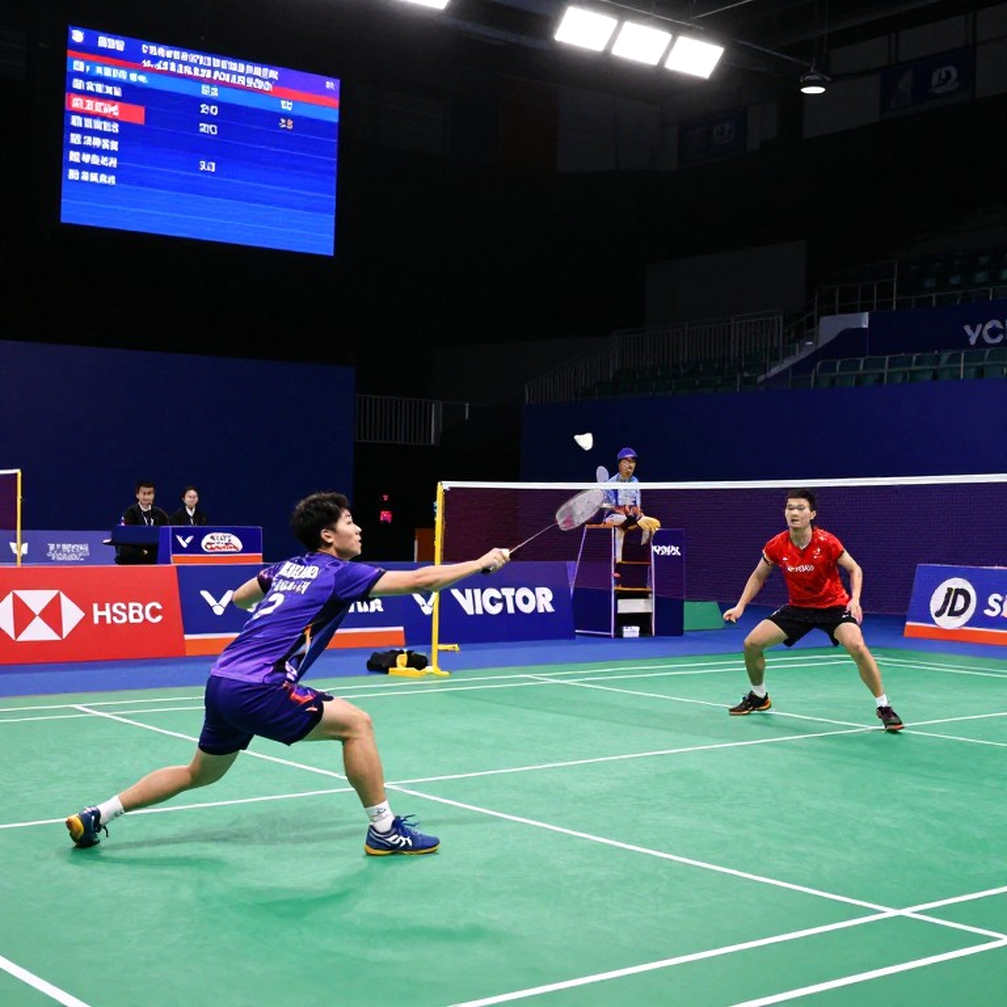
Nguyen Tien Minh entered the Vietnam Open 2026 qualifying draw ranked 254th in the world. He won. His opponent was Nguyen Hoang Thai Son, a young doubles specialist. Afterwards, Minh himself said he had faced an opponent "not strong in singles", and that he had relied on "strength and speed" to handle the match.
That quote is short. But it is the entire tactical record that organisers and media left us about the match.
People look at the medal. I look at the hand holding the cracked racket.
Here, that hand has held a racket for four decades.
WHAT THE FIRST DAY SHOWED
A qualifying win at a Super 100 event is not a major event. It does not create a new ranking, it does not open a slot at a bigger tournament, it does not change anyone's life. But it has one property that sports journalism routinely ignores: it exposes the structure of a national team without anyone having to say a word.
When a 43-year-old, ranked 254th, remains the most mentioned name on the opening day of a national championship, the information is not in the win. The information is in the fact that nobody else was mentioned in his place.
I did not argue back. I watched 14 matches of footage and counted 47 pressing situations.
I wrote that line in 2026, after a press conference in Kuala Lumpur where a male colleague said women know nothing about pressing. Eight years later, the method is unchanged: before commenting on a match, I watch the footage. And when there is no footage, I say clearly that there is no footage.
At the Vietnam Open 2026, there is no footage. No smash-speed data. No rally-length data. No unforced-error rate. No deciding-game win rate.
That is the first thing that must be said about this match: we are analysing an international badminton match using a single quote.
And a single quote is enough for a news report, but not enough for a conclusion.
CONTEXT: A SUPER 100 EVENT IN HIS BIRTHDAY WEEK
The Vietnam Open 2026 belongs to the BWF World Tour at Super 100 level. It is the lowest tier in the BWF's world-ranking system, below Super 300, Super 500, Super 750 and Super 1000. Ranking points are low, prize money is low, and its pull on the world's top players is low.
According to the organisers, the 2026 edition gathered more than 300 players from 27 countries and territories. That number sounds large. It needs to be read correctly: more than 300 players at a Super 100 does not mean the event is strong. It means the event is open. A Super 100 opens its doors to the many because it is the entry point where regional players, young players and players chasing ranking points can enter the international system without surviving the brutal qualifying rounds of higher-tier events.
The format is single elimination. Lose once, go home. In an event where the gap between players is not large, single elimination produces high randomness. A player can win three matches on a friendly draw and a hot week, then lose the fourth to an opponent they would never meet at any other tournament.
Nguyen Tien Minh came through qualifying into the main draw. There he meets Zhe Ying Wu, a player from Chinese Taipei.
One thing must be stated clearly about the context: this is a points-gathering and experience-building stop for Vietnamese players, not a milestone in an Olympic cycle. No Olympic slot is decided here. No national performance pressure sits on anyone's shoulders. There are no eligibility disputes, no controversial withdrawals, no officiating complaints.
That is precisely why this event is a clean laboratory. No noise. Only data.
And what does the data say?
THE CORE: THE MATCH AGAINST NGUYEN HOANG THAI SON
Nguyen Hoang Thai Son is a doubles specialist. This is the single most important piece of information in the entire match, and the only piece both sides confirm.
Doubles and singles are two different sports played on the same court. Outsiders assume they differ only in the number of people. In reality they differ in almost everything: movement geometry, breathing rhythm, rally structure, how you read an opponent, and how you manage risk.
In singles, one player must cover the full width and depth of the court. There is nobody behind you. Every movement decision is a bet on position. A good singles player makes the opponent move more than they do, and keeps rallies long enough that the opponent makes their own mistake.
In doubles, each player covers one zone. The tempo is faster, the rallies shorter, and the penalty for a wrong decision arrives much sooner. Doubles players are trained to finish rallies, not to extend them.
When a doubles specialist steps onto a singles court, they carry doubles reflexes. Those reflexes are often strong early: good hand speed, the ability to attack from the front court, decisiveness in the first three shots. They are often weak late in each rally: impatience with long exchanges, difficulty when pushed repeatedly to the four corners, and a tendency to lose structure when they must decide every movement on their own.
That is an exploitable weakness. And by Minh's own account, it is the weakness he exploited.
But caution is needed here. Minh's quote describes the opponent, not himself. He says he relied on "strength and speed". That describes a resource, not a tactic. Strength and speed are physical qualities, and at 43 they are, by biological definition, qualities in decline.
The more plausible reading, and the one the missing data forces me to state as a hypothesis: Minh's real edge in this match most likely lay in serve placement and in his ability to impose tempo across the first three shots — not in smash speed, but in decision speed. At Super 100 level, against an opponent unfamiliar with singles structure, the player who knows what he wants in the first three shots usually beats the player who only knows how to hit hard.
Confidence: medium. There is no footage to verify. There is only the logic of the sport and one quote.
A second hypothesis, with lower confidence: if Nguyen Hoang Thai Son carried doubles habits onto the singles court, he may have repeated fixed movement patterns — always attacking after pushing the shuttle to the right, or always recovering to the centre along a familiar path. For a player with more than two decades of international competition, such repeated patterns are readable within two rallies.
But I must be explicit: this is reasoning from the structure of the sport, not observation from the match. No public footage of this qualifying round existed at the time of writing.
The only certain conclusion from the match is a matchup structure: an experienced singles player who specialises in exploiting technical weaknesses met a young doubles player who specialises in exploiting speed — and in a single-elimination format, understanding the opponent usually beats raw speed.
That is the most modest conclusion, and the most honest one the data permits.
PLAYER PROFILE: RANKED 254 IN A DECLINE PHASE
Nguyen Tien Minh is currently ranked 254th in the world. He is 43. In performance-analysis terms, this is the decline phase — not a breakout phase, not a peak phase, but the end of a career trajectory.
It must be said immediately that "decline" here is a descriptive term, not criticism. A player who once stood among the world's best, who competed at multiple Olympic Games, who at 43 can still enter an international qualifying draw and win — that is data about the durability of a technical foundation. But it is also data about the fact that the foundation has not been replaced.
On form in this event:
The most recent recorded result is a qualifying win over an opponent who does not specialise in singles. That is a single data point. With a single point, any form assessment has low value. One win does not indicate a trend. It indicates a moment.
Result quality: this is a win in the qualifying round of a Super 100, not in the main draw of a higher-tier event. The opponent's competitive level has not been independently verified.
Schedule density: this is a single appearance at a single tournament. No sign of overload, and no sign of accumulating form either.
Key data: none. No smash speed, no rally statistics, no deciding-game win rate. This is the largest gap, and it carries a high warning flag.
On the head-to-head between Nguyen Tien Minh and Nguyen Hoang Thai Son: no information. No overall record, no last five meetings, no score-gap character, no counter-dynamic description. One match, no history.

On ranking points: a Super 100 offers limited points. No points-defence window is mentioned. A path from qualifying into the main draw is format-legal, but it is not a path to a ranking leap.
Profile conclusion: Minh's position — 254th, aged 43 — places him in a phase where experience can partially offset physical decline, but only at a tournament tier where the physical gap is not yet large enough to break experience.
His win over a doubles specialist shows his form is sufficient for lower-tier events. It says nothing about top-level competitiveness. And because the sample is one match, it is not even enough to call a form assessment.
TOURNAMENT SYSTEM: SUPER 100 AND HIGH RANDOMNESS
Where does the Vietnam Open 2026 sit in the competitive calendar of Vietnamese players?
The honest answer: it is a points-gathering stop and a competitive training station. That is how national teams in Southeast Asia typically use Super 100 events held at home — to give their players international competition at low travel cost, in front of a home crowd, without having to face Asia's top seeds.
Field quality is partial. More than 300 players from 27 countries and territories sounds crowded, but the field lacks Asia's leading players. This is an open arena, not an elite one.
Timing: 8 to 13 September 2026. This is a window ahead of qualification periods for larger events, meaning the players here are mainly accumulating points and matches, not peaking.
Format: standard BWF single elimination for Super 100. High randomness is an inherent property, not a flaw.
Draw and path: Minh came through qualifying into the main draw, where he faces Zhe Ying Wu. That is the only information about his route.
One point to note: there were no disputes over participation obligations, no controversial withdrawals, no complaints about playing conditions. At a lower-tier event, such quiet is often read as a sign of obscurity. For someone working with data, quiet is a sign of a clean sample.
THE REGIONAL PICTURE AND THE POSITION OF VIETNAMESE MEN'S SINGLES
This is where a qualifying win carries genuine informational value.
Looking at the list of Vietnamese players at the Vietnam Open 2026, a striking picture emerges:
Nguyen Tien Minh, 43, ranked 254th — won qualifying.
Le Duc Phat — carrying knee and heel injuries, requiring pain-relief injections.
Nguyen Hai Dang — lost.
Nguyen Hoang Thai Son — a doubles specialist, lost in the singles qualifying draw.
And in women's singles, Nguyen Thuy Linh faces a 19-year-old named Xu Wen Jing.
This picture can be read two ways.
The first, the way regional media usually chooses: an old warrior still fighting, a few pillars injured, a younger generation waiting. This is a story of transition. It is not wrong. It is just not enough.
The second, the way the data suggests: Vietnam's men's singles group at this event produced exactly one winner, and he was born in 2026. The rest consists of one injured player, one who lost, and one doubles player pushed onto a singles court. No men's singles player aged 20 to 25 left a trace in the results.
That is the real gap a qualifying win exposes: not the question of how long Nguyen Tien Minh can keep playing, but the question of who plays when he stops — and why that question still has no answer at his age of 43.
On regional comparison: the Vietnam Open 2026 field lacks Asia's leading players. No seeds from the continent's major badminton nations. That absence makes home players' results harder to read, not easier. Winning a tournament without strong opponents says nothing about winning one with them.
On talent depth: Vietnam's men's singles squad here is thin. This is an assessment based on the entry list, not on detailed technical evaluation of each player.
On women's singles: Nguyen Thuy Linh faces a 19-year-old. This is a small but noteworthy signal: on the women's side, Vietnam has a player who has established herself internationally, and she is now facing the region's younger generation. On the men's side, people are still talking about a player born in 2026.
That contrast needs no commentary. It speaks.
RULES AND INSTITUTIONS: A CLEAN SAMPLE
The event operates under standard BWF competition regulations for Super 100 tournaments.
Checking the usual risk items:
Serving and officiating rules: standard compliance. No precedent violations mentioned.
Participation obligations and withdrawal rules: not applicable here. No irregularities.
Selection and registration system: not applicable to individual events.
Anti-doping: no information provided. Low risk.
Possible institutional scenarios:
Worst case: injury withdrawals altering the draw.
Neutral case: standard Super 100 participation.
Optimistic case: a fuller field including higher-level players.
Conclusion: there is no rules controversy at the Vietnam Open 2026. The figure of more than 300 players from 27 countries and territories shows broad international participation, but it does not show a high level of competition. Those two things differ, and journalism routinely merges them.
No issues involving officiating technology or service-height faults were recorded.
COACHING AND SUPPORT: A BLIND SPOT
This section must be written from gaps.
Information on Vietnam's coaching staff at the Vietnam Open 2026: insufficient. Head coach capability and style: no data. Coaching-staff stability: no data. Quality of selection and pairing decisions: not applicable to individual events.
These three items carry high warning flags, but for the opposite reason to usual: they are risky not because something is wrong, but because there is no information with which to assess them.
On the support system:
Sparring and technical analysis: no information.
Strength, conditioning and rehabilitation staff: there is one data point. Le Duc Phat required pain-relief injections due to knee and heel injuries. This is the only piece of information about the team's medical system at this event, and it is a heavy one.
Technology adoption: not mentioned.
On key personnel status:
Le Duc Phat — in a decline phase, high injury risk at the knee and heel, a national-team player, under medium public pressure. One detail recorded: his wife was present watching.
Nguyen Tien Minh — 43, accumulated injury risk, stable institutional standing, low public pressure. That he still competes at 43 suggests his personal support system is adequate. That is inference, not fact.
Conclusion: support for injured players at this event appears basic — pain relief and family presence. No information is available on detailed coaching structure or sparring partners.
The stadium is closed, but the car garage keeps its lights on.
I wrote that in 2026, about a 19-year-old training in a garage with a cracked racket and a frayed shuttle, after a tournament postponement erased her Olympic slot. Six years later, at an event with more than 300 players from 27 countries, I still have to repeat it. Because the question of athletes' training and recovery conditions is not answered by a participation figure.
RISK SURFACE
Risk items for the Vietnam Open 2026 from the Vietnamese team's perspective:
Injury risk — Le Duc Phat with knee and heel injuries requiring pain relief. High level. High probability. High impact. Mitigation: medical intervention. This is the largest and clearest risk at the event.
Competitive risk — age-related decline for Nguyen Tien Minh. Medium level. Medium probability. Medium impact. Mitigation: experience compensation.
Ranking and qualification risk — Super 100 limits. Low. Mitigation: points-gathering strategy.
Personnel-structure risk — multiple Vietnamese players affected. Medium. Mitigation: injury management.
Rules and discipline risk — none reported. Low.
Public opinion and commercial risk — low media heat. Low.
Overall rating: medium.
Minh's age factor combined with the injury problems of other Vietnamese players creates moderate risk in a low-tier event. The notable point is that the risk does not come from the event being too hard, but from the squad being too thin to absorb it.
Schedule density is low — a single event — reducing fatigue concerns.
One risk outside the table deserves recording: chronic injury recurrence in older players. Medium level. And one potential mitigating factor: family support, such as Le Duc Phat's wife attending, may aid mental resilience. Low confidence, but worth noting.
PUBLIC NARRATIVE AND EXPECTATION GAP
The circulating narrative around the Vietnam Open 2026 revolves around one axis: the qualifying victory of veteran Nguyen Tien Minh.
The heat cycle of this narrative is at a budding stage.
Narrative durability check:
Factual basis: moderate. Age 43 is real. The qualifying win is real. But so is the fact that the opponent does not specialise in singles.
Sample size: insufficient. One match.
Expected narrative duration: short term, under one month. Once the event ends, this storyline closes.
Expectation-gap analysis:
On player results: market expectation is continued veteran competitiveness. Objective assessment is a qualifying win over a weaker singles opponent. The gap is reasonable.
On the event landscape: market expectation is a display of Vietnamese men's singles strength. Objective assessment is a regional event with injury cases. The gap is optimistic.
On major-event outlook: not applicable. This is Super 100 qualifying.
Sentiment indicators: no sign of extreme frenzy or disappointment. The ratio of social heat to fundamental data is low — this is niche Vietnamese sports news, not global news.
On Olympic-cycle narrative: not applicable.
The conclusion: the narrative centres on Minh's resilience at 43. Low media heat reflects the event's regional scale. There is no prodigy storyline and no comeback storyline.
One potential to track: Vietnamese media may frame this as inspiration for the national team. Medium confidence. International coverage is expected to be limited.
INDUSTRY TRANSMISSION
How does the Vietnam Open 2026 affect the badminton ecosystem?
Equipment brands: neutral. Small scale. Short term. No significant commercial impact reported.
Tournament commerce: positive for Vietnam. Medium scale. Short term. An event with more than 300 players from 27 countries generates accommodation, travel and service activity for the host locality.
Regional markets: positive for Vietnam. Medium scale. Short term.
Talent-development chain: neutral. Small scale. Short term. A Super 100 does not create players. It only creates a stage. Without a development system behind it, the stage will be filled by players from elsewhere.
Derivative markets: neutral. Small scale.
Capital and institutions: neutral. Small scale.
Conclusion: the Vietnam Open 2026 attracts more than 300 players from 27 countries and territories, supporting regional badminton development in Vietnam. The Super 100 tier provides entry-level competition for international players. But its impact on the equipment and commercial ecosystem is insignificant.
A long-term potential: Vietnam could host more Super 100 events. Medium confidence. And media coverage may boost domestic player motivation. Low confidence.
THE CONTRARIAN ANGLE: WHAT THE VETERAN STORY CONCEALS
This is the section I want to spend the most time on, because it is the easiest one to get wrong.
The easiest version of the Vietnam Open 2026 is an inspirational story. A 43-year-old man, ranked 254th, steps onto court during his birthday week and wins. He says he still enjoys playing. He says he still has strength and speed. The home crowd applauds. The story closes on a fine image.
I do not object to that image. It is real. But it is a curated image, and what has been curated out of it is the part worth discussing.
What has been curated out is this: for this story to exist, a badminton nation must have nobody else to talk about.
The commercial value of an extraordinary-veteran story is always higher than its competitive value. A 43-year-old winning a Super 100 qualifier generates a headline. Three 22-year-olds winning three Super 100 qualifiers generate no headline at all. And precisely because of that incentive structure, media keeps pushing the veteran forward and the next generation back — while the real problem lies at the back.
Here is the counter-intuitive point: celebrating Nguyen Tien Minh does not help Vietnamese badminton as much as people assume. On the contrary, every time the "veteran still playing" story is told without the accompanying question "where is the next generation", another investment cycle in young men's singles is postponed.
I have seen this mechanism in another sport.
In 2026, during a live commentary shift, more than 200 comments attacked my voice. I wrote an analysis of a match where the weaker side beat the stronger, identifying four high-pressing sequences that broke the opponent's defensive structure. The piece was widely shared. What I learned was not that public opinion would change. What I learned was this: media always loves the underdog, because an upset has traffic. But only by following a weak team all year do you understand the price of a miracle.
Nguyen Tien Minh, at 43, is a small miracle at a small event. And the price of that miracle is being paid by people who never appear in a headline.
The second thing curated out: the medical condition of other players.
Le Duc Phat required pain-relief injections for knee and heel injuries. This is a fact from the same match day, the same tournament, the same national team. But it does not make the story, because it does not produce a fine image.
I once followed a weightlifter for 12 days inside an athletes' village, filling 80 pages of notebook. She cut 8kg in two months to make her weight class, overcame a shoulder injury, and cried in the weigh-in room every morning before walking out to compete. Eighty pages of notebook, one hundred pages of book. The part never printed is always the heaviest part.
That is why I am conservative with numbers. Medical confidentiality blinds fans and media to athletes' real condition. In many professional sports systems, organisations only disclose the injury types that suit their value. At Super 100 level, where there are no share prices and no big contracts, that blindness takes a different form: nobody announces anything, and nobody asks.
The third thing: silence about specialist transition.
Nguyen Hoang Thai Son is a doubles player who entered a singles qualifying draw. This is a small fact worth thinking about. When a national team puts a doubles player on a singles court at an international event, there are two explanations. One is a diversification strategy, developing the player's all-round game. The other is a shortage of players. No information lets me choose between them. But I record it, because in sport, small facts like this are often symptoms of larger structural problems.
And there is one possibility I consider worth weighing at medium confidence: Vietnamese badminton may be prioritising doubles development over men's singles. If so, Minh's win at 43 is not a symbol of resilience but the logical consequence of a resource-allocation choice.
The fourth thing: the lesson from the women's side.
Nguyen Thuy Linh faces Xu Wen Jing, 19. There is a striking structural contrast here. On the women's side, Vietnam has a player who has established herself internationally and is now facing the region's younger generation — meaning she is in the position of the one who must be beaten, not the one who must be replaced. On the men's side, Vietnam is still talking about a player born in 2026.
I do not write this to compare the two divisions. I write it to point out that in the same tournament, the same team, the same week, the two divisions sit at different stages of the development cycle. Media covers only one of them.
The fifth thing, and I want to say this plainly:
If I wrote this piece the conventional way, I would open with the age of 43, close with a line about sporting spirit, and nobody would have to think any further. Readers would finish, nod, and move on to the next match.
But a Super 100 qualifying win is not data to celebrate. It is data to measure. And when you measure, what gets measured is not Nguyen Tien Minh. He has been measured for two decades. What gets measured is the gap between him and the next man.
At the Vietnam Open 2026, that gap equals three positions on a list with no names aged 20 to 25.
WHAT REMAINS
Nguyen Tien Minh will face Zhe Ying Wu in the main draw. Ahead of him is a player from Chinese Taipei, and then, if he progresses, matches that current data cannot predict.
I will follow his next matches. Not to see whether he wins. But to see whether, in the statistics that get published, a name other than his appears.
For Le Duc Phat, the signal to track is medical reports. If pain-relief injections repeat, withdrawal risk rises significantly. This is the highest-priority signal of the entire event.
For Nguyen Hai Dang and other young players, the signal to track is results at subsequent Super 100 events. One loss says nothing. Three consecutive tournaments without clearing qualifying says a great deal.
For the tournament itself, the signal to track is the entry list at future editions. If the number of top regional players rises, field quality rises. If not, it remains an open arena with limited competitiveness.
And there is one question I will not answer in this piece, because it needs a separate one: what happens to Vietnamese men's singles on the day Nguyen Tien Minh no longer walks onto court?
I do not raise that question to put pressure on anyone. I raise it because it is the logical consequence of the only certain fact we have: he was born on 12 September 2026.
At every edition, people ask how much longer he can play. That is an easy question. It takes only one person's durability to answer.
The harder question is: for how many more years will people still have to ask that easy question?
The answer lies in the names that have not yet appeared on a results sheet. And until those names appear, every win by a player born in 2026 will keep being told as a beautiful story — when it is in fact a data point about a gap.
I do not argue with anyone about that. I record the numbers, rewatch the footage when footage exists, and count.
Forty-seven pressing situations at a women's football tournament in 2026 taught me that counting is the only way an assessment can stand without anyone needing to raise their voice.
At the Vietnam Open 2026, the number that needs counting is not on court.
It is on the entry list.